Complimentary Shipping on orders over $100

EST. 2024

We Built the
Racquet We
Couldn't Find

Walk...

into any sporting goods store and the story is the same: rows of identical racquets in aggressive colorways designed for a demographic that doesn't include us. Performance paddles that look like they were designed by someone who's never stepped on a court. Or pretty paddles with the engineering of a cutting board.

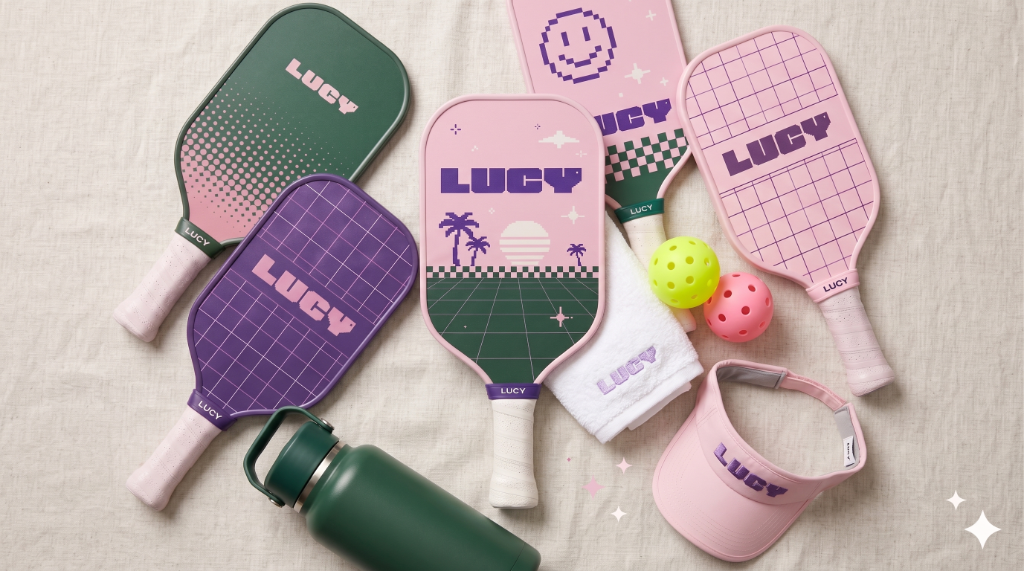
LUCY was born from a simple frustration: why can't a racquet be both? Why can't the paddle that wins you the match also be the one you're proud to carry into brunch afterward?

Every...

LUCY racquet is produced in micro-batches. 80 to 250 units per colorway, per drop. When they're gone, the design retires forever. This isn't marketing — it's a commitment to craft. Each paddle undergoes 72 hours of quality testing. Each design is a collaboration between athletes and artists.

We don't do mass production. We don't do wholesale. We don't discount. We make the best racquets in the world for humans who play to win — and look incredible doing it.

OUR VALUES

Performance First

T700 carbon fiber, polypropylene honeycomb cores, and precision-tuned sweet spots. Every LUCY paddle is built to compete at the highest level.

Design Always

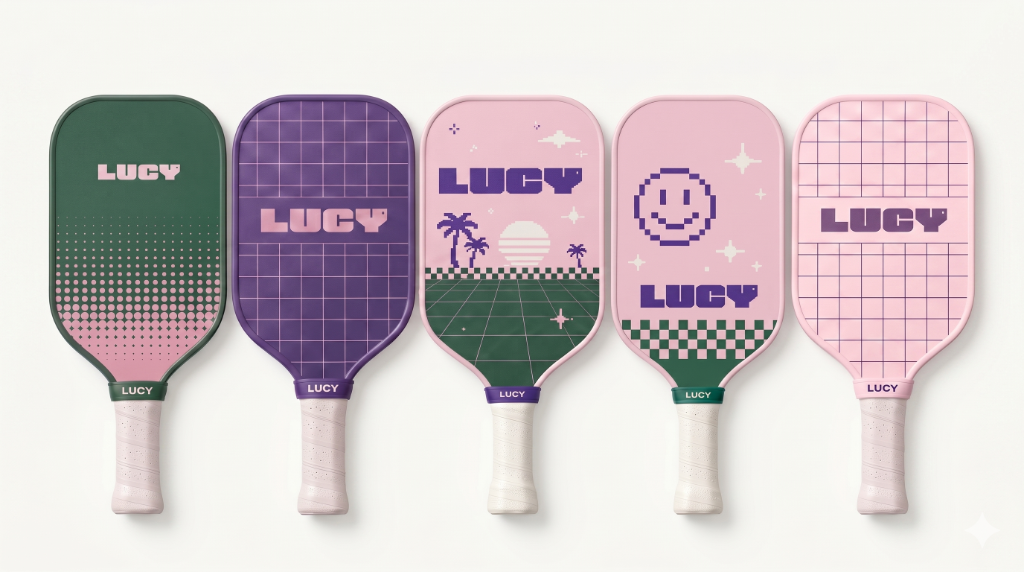
Retro-future aesthetics meet modern minimalism. Our pixel-art collections are instantly recognizable on any court.

Scarcity by Design

Micro-batch production ensures quality and exclusivity. When a colorway sells out, it becomes a collector's piece.

FROM THE TEAM

Journal

Padel vs Pickleball: Which Racquet Sport Is Right for You?
May 23, 2026— LUCY

Padel vs Pickleball: Which Racquet Sport Is Right for You?

Two of the world's fastest-growing racquet sports — but which one deserves a spot in your bag? We break down the differences, the culture, and what it takes to play both.

Padel and pickleball are two of the fastest-growing racquet sports on the planet — and if you've been paying attention, you've probably been asked at least once: "which one do you play?" The honest answer? Both. And here's why that's the right answer. WHAT IS PADEL? Originating in Mexico in the late 1960s and exploding across Europe and Latin America, padel is played on an enclosed glass and mesh court roughly a third the size of a tennis court. Balls bounce off the walls — like squash — creating a dynamic, high-energy game that's equal parts strategy and reflex. The paddle is solid with holes (no strings), and the ball is slightly depressurised compared to a tennis ball. Games are typically played in doubles, which makes it inherently social. That's a big part of the appeal. WHAT IS PICKLEBALL? Born in the USA in 1965 and now the fastest-growing sport in America, pickleball is played on a court the size of a badminton court — either indoors or outdoors. The paddle is solid composite or carbon fiber, and the ball is a lightweight plastic wiffle ball. The "kitchen" (non-volley zone) adds a chess-like layer of tactics to what can look, from a distance, like a casual game. Don't be fooled — elite pickleball is fast, technical, and physically demanding. THE KEY DIFFERENCES Court: Padel courts are enclosed with glass walls that are in play. Pickleball courts are open with defined boundary lines. Social dynamic: Padel is almost exclusively doubles. Pickleball is flexible — singles or doubles. Learning curve: Both sports are famously beginner-friendly, but most players find the first few rallies of pickleball easier to sustain. Padel's wall element takes time to read. Physical demand: Both provide excellent cardio. Padel can be more physically intensive for experienced players due to the larger court and wall play. Pickleball's smaller court demands quicker hands and fast-twitch reactions. Culture: Padel carries a European elegance — social clubs, post-match aperitivos, stylish kit. Pickleball has an American energy — competitive leagues, paddle tech obsession, and a community-first mentality. WHY LUCY PLAYS BOTH At LUCY, we didn't build our paddles for one type of player. We built them for the athlete who understands that the best racquet sport is the one in front of you right now. Our padel collection is engineered with T700 carbon fiber faces and polypropylene honeycomb cores — delivering the pop and control you need to master wall play. Our pickleball paddles are weight-optimised for quick exchanges at the kitchen line, with the same obsessive attention to balance and sweet-spot precision. Both sports reward players who invest in their equipment. A well-balanced paddle — whether padel or pickleball — changes the way you move, the way you strike, and the confidence you carry onto the court. THE VERDICT If you're choosing between padel and pickleball, our advice is: don't. The crossover skills are real — hand-eye coordination, court positioning, reading pace and spin — and playing both will make you sharper at each. What matters most is that you're on a court, paddle in hand, playing a sport you love. Shop LUCY's padel and pickleball collections — micro-batch drops, built to perform and designed to be seen.

READ MORE →
Why Micro-Batch Matters: The LUCY Philosophy
April 15, 2026— THE LUCY TEAM

Why Micro-Batch Matters: The LUCY Philosophy

We make fewer racquets on purpose. Here's why that changes everything.

Most sporting goods brands operate on a simple equation: more units equals more profit. We built LUCY on the opposite logic. Every LUCY paddle is produced in a run of 80 to 250 units. That's it. When they're gone, the colorway is retired. Forever. No restocks, no clearance sales, no endless inventory sitting in a warehouse. This isn't scarcity for marketing's sake. It's a manufacturing philosophy. Smaller runs mean tighter quality control. Every paddle gets 72 hours of stress testing. Every grip wrap is checked by hand. Every face surface is inspected under light for micro-imperfections before it ever leaves the factory. The result is a racquet that performs like a precision instrument because it's made like one. When you hold a LUCY paddle, you're holding one of fewer than 250 that will ever exist in that exact form. We think that matters. We think you do too.

READ MORE →
Carbon Fiber 101: What Makes a Paddle Actually Fast?
March 28, 2026— R&D

Carbon Fiber 101: What Makes a Paddle Actually Fast?

Not all carbon is created equal. A breakdown of what's inside your LUCY.

When we say T700 carbon fiber, we're not just dropping a spec number for marketing purposes. T700 is a tensile strength rating — it refers to how much pulling force the material can withstand before it breaks. At 700 kilonewtons per square millimetre, it's the same grade used in aerospace structural components. For a paddle, this translates directly into two things: power transfer and durability. A stiffer face means energy from your swing reaches the ball more efficiently. Less flex in the frame means the paddle holds its shape drop after drop, year after year. Paired with our polypropylene honeycomb core — which absorbs vibration while maintaining a responsive sweet spot — the result is a paddle that feels alive in your hand without punishing your arm on off-centre hits. We spent 14 months on material sourcing before we made a single production paddle. We're not going to apologise for being particular.

READ MORE →
Designing the Retro Wave Collection
February 10, 2026— CREATIVE

Designing the Retro Wave Collection

How 1980s synth aesthetics ended up on a carbon fiber pickleball paddle.

The Retro Wave collection started with a single reference image: a 1984 Roland Juno-106 synthesizer in dusty rose and chrome. We were obsessed with the contrast — something technically precise dressed in something visually soft. Our design process for each collection starts analog. Sketches on paper, colour swatches pinned to a board, reference materials from fashion, music, and industrial design that have nothing to do with sport. We intentionally avoid looking at other paddle brands during this phase. We don't want to iterate on what exists. We want to create something that belongs somewhere else and ends up on a court. The gradient fade on the Retro Wave face took 11 iterations to get right. The chrome edge detail was almost cut for cost reasons twice. We kept it both times. Some things are worth the extra work. When the first production sample arrived, we put it on the court and won the point. That felt right.

READ MORE →
ANSWERS

FAQ

ARE YOU ON THE LIST?

Inner Circle members get first access to drops, exclusive colorways, and limited-edition collections before anyone else.

LUCY© 2026 LUCY. ALL RIGHTS RESERVED.